Showing posts with label US Politics. Show all posts
Showing posts with label US Politics. Show all posts
Tuesday, June 12, 2007
A new twist to blue on blue
According to The Guardian the US is currently arming Sunni dissidents in Iraq. Apparently "Arms, ammunition, body armour and other equipment, as well as cash, pick-up trucks and fuel, have already been handed over in return for promises to turn on al-Qaida and not attack US troops". Whether or not such promises extend to British troops is not clear and frankly from the tone of the article there seems to be a fair amount of scepticism as to whether or not the Sunni dissidents can be relied upon to hold to their promise. American forces already have quite a reputation for so called "Blue on Blue" incidents otherwise known as friendly fire - blue being the friendly forces and red being the enemy forces. I guess this will lead to cases of purple on blue where US forces will be killed and injured by enemy combatants firing bullets supplied by the US. And we wonder why we are so mired in Iraq!


Saturday, December 16, 2006
Democratic control of Senate hangs by a thread
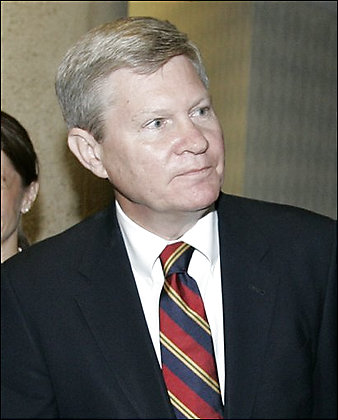
I have not seen this reported anywhere on this side of the pond but according to the Washington Post here Senator Tim Johnson a Democrat from South Dakota is critically ill in hospital recovering from stroke like symptoms and emergency brain surgery.
Were he to fail to take his seat in the Senate a replacement would be nominated by the Governor of South Dakota Mike Rounds. Governor Rounds just happens to be a Republican. In the new Senate the split is currently 51 Democrats (including 2 independents who say they will vote with the Democrats) and 49 Republicans. If the Governor were to appoint a fellow Republican this would tie the senate 50 50.
In such a situation the casting vote would go the President of the Senate - otherwise known as the Vice President of the United States one Dick Cheney!
Sunday, November 19, 2006
Bush understands
At least according to The Nation here. Well I guess there is a first time for everything.
According to The Nation "Despite Washington's disapproval of the coup that usurped power on September 19, US President George Bush said yesterday he understood the situation in Thailand and shook hands with military-installed Prime Minister Surayud Chulanont on the sidelines of the Apec leaders summit"
Prime Minister Surayud Chulanont assured the Apec leaders that the country would "proceed along the democratic path" and would "try to put the draft of the constitution to a referendum later on."
The US had criticised the military takeover in Thailand, saying the move was a step backward for democracy. Washington has suspended parts of military cooperation as well as bilateral free-trade negotiations, pending the election of a new government.
I know which of the two lines I prefer and which is more likely to keep the coup leaders to their promise with regard to fresh elections.
According to The Nation "Despite Washington's disapproval of the coup that usurped power on September 19, US President George Bush said yesterday he understood the situation in Thailand and shook hands with military-installed Prime Minister Surayud Chulanont on the sidelines of the Apec leaders summit"
Prime Minister Surayud Chulanont assured the Apec leaders that the country would "proceed along the democratic path" and would "try to put the draft of the constitution to a referendum later on."
The US had criticised the military takeover in Thailand, saying the move was a step backward for democracy. Washington has suspended parts of military cooperation as well as bilateral free-trade negotiations, pending the election of a new government.
I know which of the two lines I prefer and which is more likely to keep the coup leaders to their promise with regard to fresh elections.
Monday, October 23, 2006
12 months to go
So the UK is not going to throw in the towel in Iraq and we are not going to set a deadline for withdrawal so thats ok then. I am not sure what this piece in the Guardian is referring to then.
The piece certainly gives the impression that the UK is at least setting an unofficial deadline for withdrawal. Kim Howells said "I would have thought that certainly in a year or so there will be adequately trained Iraqi soldiers and security forces - policemen and women and so on - in order to do the job."
He may genuinely think that but I would suggest that three years down the road there is precious little evidence that the Iraqi security forces are efficient enough, effective enough, numerous enough and determined enough to bring order, stability and security to a country that is effectively in the middle of a civil war.
The Americans too seem to be singing from the same song sheet according to this piece in the Guardian The article says "the Bush administration, alarmed by the increasing violence and lawlessness gripping much of Iraq, has decided to force the hand of the embattled prime minister, Nuri al-Maliki. It will push him to agree to a timetable of specific measures aimed at disarming the militias, halting sectarian violence, and shouldering more responsibility for the country's security." In other words sort things out and take responsibility for your own security so we can leave.
Whatever happens with British and American troops and their timetable (or not) for withdrawal I think it is inevitable that the final solution for Iraq will involve the Balkanisation of the country. Sooner or later Iraq will split into a number of smaller states most probably three. It seems probable that there is nothing now that the coalition forces or internal Iraqi security forces can do to prevent that. I hope I am wrong and that some miracle occurs and order is re-established as soon as possible. But it does not seem likely.
The piece certainly gives the impression that the UK is at least setting an unofficial deadline for withdrawal. Kim Howells said "I would have thought that certainly in a year or so there will be adequately trained Iraqi soldiers and security forces - policemen and women and so on - in order to do the job."
He may genuinely think that but I would suggest that three years down the road there is precious little evidence that the Iraqi security forces are efficient enough, effective enough, numerous enough and determined enough to bring order, stability and security to a country that is effectively in the middle of a civil war.
The Americans too seem to be singing from the same song sheet according to this piece in the Guardian The article says "the Bush administration, alarmed by the increasing violence and lawlessness gripping much of Iraq, has decided to force the hand of the embattled prime minister, Nuri al-Maliki. It will push him to agree to a timetable of specific measures aimed at disarming the militias, halting sectarian violence, and shouldering more responsibility for the country's security." In other words sort things out and take responsibility for your own security so we can leave.
Whatever happens with British and American troops and their timetable (or not) for withdrawal I think it is inevitable that the final solution for Iraq will involve the Balkanisation of the country. Sooner or later Iraq will split into a number of smaller states most probably three. It seems probable that there is nothing now that the coalition forces or internal Iraqi security forces can do to prevent that. I hope I am wrong and that some miracle occurs and order is re-established as soon as possible. But it does not seem likely.
Saturday, October 21, 2006
Is this the end game playing out?
Iraq and US and British foreign policy vis-a-vis Iraq has been a disaster ever since Bush decided he was going to oust Saddam come what may and with whatever pretext. As I recall he initially thought Baghdad was responsible for the attack on the twin towers.
This article in the Guardian indicates that efforts are under way in Washington and London to find an exit strategy for Iraq.
Here in the UK the Chief of the General Staff has said what everyone else has been thinking for some considerable time. He should not have said it but it does not make it any less true just because he ought not to have said. Tony Blair has been forced to state that he supports what General Sir Richard Dannatt said even though there is considerable doubt as whether or not he really does.
Back across the pond it is clear that the Americans are also having a rethink and as I suggested before it appears that Blair does not want to act unilaterally and is awaiting guidance and direction from Washington. That guidance will appear doubtless after the US mid term elections when James Baker's commission will publish its recommendations. Having said that Bush is clearly laying the ground for a possible withdrawal and is consulting his generals according to this piece from the BBC.
If this really is the case then Blair should think very carefully before authorising British forces to go back into Amara with a view to retaking it. This city was handed over to the Iraqis just two months ago and now appears to be in chaos with 800 militiamen said to be in control. There is little point sending British troops into a blood bath if both London and Washington are starting to move towards acceptance of the fact that withdrawal is inevitable.
A futher Guardian article which can be found here goes on to outline eight possible options which are said to be under discussion between London and Washington.
The eight options with their pros and cons are as follows :
1 British out now
One of the British diplomats involved in talks on Iraq policy said the UK, which has responsibility for the south of Iraq, "could go tomorrow almost ... It would not look pretty, but it is doable".
Against British diplomats pinpoint three problems if the UK was to pull out immediately. One would be political: the US would not welcome being left virtually alone. The second is military: the US would no longer have a dependable force in the south. The third is security: without British forces in place, fighting between the various militia groups and the criminal gangs in Basra and elsewhere would intensify.
For The British presence is part of the problem. If Basra, Amara and other places were to disintegrate after British forces leave, the FCO hopes Shia religious leaders and Iran, which has influence over the Shia, could quickly establish stability.
Likelihood Not being seriously considered yet. Halving British forces next summer, with further reductions later on, is still the likeliest outcome.
2 US coalition out now
"We could pull out now and leave them to their fate," a Foreign Office official said. "But the place could implode." The advantage of this option would be to cut short the agony.
Against A premature pull-out could precipitate an even more ferocious civil war. Faced with world outrage over the level of human rights abuses and carnage, the US might then have to consider going back in circumstances even worse than before.
For The presence of US forces is making things worse. The insurgency would lose its patriotic justification. A pull-out might force the Iraqi parties and security forces to work together or face a descent into anarchy.
Likelihood Such an early exit is unlikely. It would be an unpalatable humiliation for the Bush administration and most of its critics agree that a hasty withdrawal could ultimately oblige the troops to go back.
3 Phased withdrawal
This is the present policy, but any pull-out is contingent on Iraq developing its own security forces. But there are increasing calls in Washington and London for a timetable. A Foreign Office official said: "The date might possibly have to be secret." Otherwise it could encourage insurgents to step up attacks. During this stage, the US could pour in money for employment programmes.
Against The risk of agreeing a secret date with the Iraqi government is that, as with much else in Iraq, the date would probably leak out anyway.
For The prospect of the removal of its security blanket might force the Iraqi government to face up to the many issues it ignores at present, such as the rise in sectarian violence. It also allows more time for training the Iraqi army and trying to train and reform the police force, a policy that has so far proved to be slower than coalition forces had hoped.
Likelihood Still the likeliest option.
4 Talk to Iran and Syria
There appears to have been virtual consensus in the Baker commission for talks with Iraq's two most difficult neighbours on the grounds that they must ultimately want stability but will not pursue it while excluded from negotiations. The FCO, which has an embassy in Tehran, is pushing for engagement too.
Against Iran and Syria could make demands in return for help that the Bush administration would find hard to accept. Iran would, at a minimum, demand that the US stop calling for regime change. Syria could urge the US to put pressure on Israel to return the Golan Heights, lost in the 1967 Arab-Israeli war. There is some question over whether either country could stop sectarian killings.
For Whatever the limitations of their influence, the bloodshed is only likely to worsen until they are brought on board.
Likelihood There may be too much resistance in the Bush administration to direct talks, but the US could well give the nod to negotiations between a sovereign Iraq and its powerful neighbours.
5 Iraqi strongman
The US and British governments have been disappointed so far with Nuri al-Maliki, Iraq's elected prime minister who took over earlier this year, mainly over the reluctance of his Shia-dominated coalition to tackle Shia death squads. Washington and London could press for his replacement with a strongman at the head of a junta, such as Ayad Allawi, the interim prime minister from 2004-05 - and roll back democracy.
Against Ousting a democratic government, with its carefully crafted constitution, would amount to a scandalous policy failure. "I do not see that as an option for western democracies," a British official said. Allawi is treated with suspicion by religious Shias because he is secular and detested by Sunnis because he presided over the attack on Falluja.
For Only a strong, secular Iraqi leader could break the sectarian deadlock and broker the kind of compromises over oil and regional autonomy that are essential to prevent civil war and keep the country together.
Likelihood Not likely.
6 Break-up of Iraq
Iraq is moving towards a federal model that could result in its break-up. The Kurdish area to the north is virtually autonomous anyway. The Shia-dominated area stretching from Basra in the south to the holy cities of Kerbala and Najaf further north could form another bloc, leaving the Sunnis with much of the west and centre - mostly oil-free desert. Advocates of such partition talk about using coalition forces to escort minority populations across the ethnic divides to streamline the partition and working out a fair revenue-sharing formula for oil.
Against The break-up would leave a power vacuum in the region, which Iran, Syria and Turkey could exploit. The partition of Iraq would not be easy. Baghdad, which has huge Sunni and Shia communities, could explode.
For The sectarian killings are creating de facto partition. Military escorts for civilians displaced by the violence would at least reduce the death toll.
Likelihood Events on the ground may make it inevitable.
7 Redeploy & contain
There are two variations. One is for US forces to leave populated areas and retreat to "super-bases" in the desert from where they could support Iraqi forces - something the army has already begun. An alternative would be for the US forces to move out of Iraq altogether and use bases in nearby countries.
Against "Super-bases could be the worst of both worlds," argues Larry Diamond, a former adviser to the Coalition Provisional Authority. The troops would be too cut off from the streets to have much impact, but they would remain foreign occupiers. It could be difficult to persuade other Arab countries to provide bases, and once out, it will be harder going back. It could also be perceived as cutting and running.
For US forces would no longer be in the firing line and with them gone, the motivation for many of the insurgents might evaporate. They would still be at hand to prop up the elected government.
Likelihood Quite possible in the short term as the US tries to stem its casualties, but unlikely as a lasting solution.
8 One last push
This would involve an increase of troops in the short term in the hope of creating sufficient security to deliver economic gains and create confidence in the Iraqi government. This roughly is Senator John McCain's preferred option, but might also appeal to Mr Bush as it would not immediately require a policy U-turn.
Against It might be too late to curb the escalating violence and it would be politically unpalatable at home. It could leave even more US forces stuck in the middle of a civil war.
For Military experts have long said there are not enough coalition forces in Iraq to seal the borders against infiltration and stamp out sectarian killings. It would be a sign of backing for the Baghdad government and would force sectarian leaders to take it more seriously.
Likelihood A final gamble by Mr Bush is not to be discounted. Senator McCain is a presidential frontrunner for 2008, but by then Iraq may look very different.
My Opinion
Option 3 (Phased withdrawal) may be the current policy and may in the opinion of the Guardian still be the likeliest outcome. If they mean in the short term then they may be correct. However, in the long run I suspect that the outcome will be option 6 (break up of Iraq) whether or not the tricky question of oil revenues can be resolved or not. The country is virtually in the throws of a civil war in any case and there are clearly areas which are likely strongholds for each of the Kurds, Shias and Sunnis.
This article in the Guardian indicates that efforts are under way in Washington and London to find an exit strategy for Iraq.
Here in the UK the Chief of the General Staff has said what everyone else has been thinking for some considerable time. He should not have said it but it does not make it any less true just because he ought not to have said. Tony Blair has been forced to state that he supports what General Sir Richard Dannatt said even though there is considerable doubt as whether or not he really does.
Back across the pond it is clear that the Americans are also having a rethink and as I suggested before it appears that Blair does not want to act unilaterally and is awaiting guidance and direction from Washington. That guidance will appear doubtless after the US mid term elections when James Baker's commission will publish its recommendations. Having said that Bush is clearly laying the ground for a possible withdrawal and is consulting his generals according to this piece from the BBC.
If this really is the case then Blair should think very carefully before authorising British forces to go back into Amara with a view to retaking it. This city was handed over to the Iraqis just two months ago and now appears to be in chaos with 800 militiamen said to be in control. There is little point sending British troops into a blood bath if both London and Washington are starting to move towards acceptance of the fact that withdrawal is inevitable.
A futher Guardian article which can be found here goes on to outline eight possible options which are said to be under discussion between London and Washington.
The eight options with their pros and cons are as follows :
1 British out now
One of the British diplomats involved in talks on Iraq policy said the UK, which has responsibility for the south of Iraq, "could go tomorrow almost ... It would not look pretty, but it is doable".
Against British diplomats pinpoint three problems if the UK was to pull out immediately. One would be political: the US would not welcome being left virtually alone. The second is military: the US would no longer have a dependable force in the south. The third is security: without British forces in place, fighting between the various militia groups and the criminal gangs in Basra and elsewhere would intensify.
For The British presence is part of the problem. If Basra, Amara and other places were to disintegrate after British forces leave, the FCO hopes Shia religious leaders and Iran, which has influence over the Shia, could quickly establish stability.
Likelihood Not being seriously considered yet. Halving British forces next summer, with further reductions later on, is still the likeliest outcome.
2 US coalition out now
"We could pull out now and leave them to their fate," a Foreign Office official said. "But the place could implode." The advantage of this option would be to cut short the agony.
Against A premature pull-out could precipitate an even more ferocious civil war. Faced with world outrage over the level of human rights abuses and carnage, the US might then have to consider going back in circumstances even worse than before.
For The presence of US forces is making things worse. The insurgency would lose its patriotic justification. A pull-out might force the Iraqi parties and security forces to work together or face a descent into anarchy.
Likelihood Such an early exit is unlikely. It would be an unpalatable humiliation for the Bush administration and most of its critics agree that a hasty withdrawal could ultimately oblige the troops to go back.
3 Phased withdrawal
This is the present policy, but any pull-out is contingent on Iraq developing its own security forces. But there are increasing calls in Washington and London for a timetable. A Foreign Office official said: "The date might possibly have to be secret." Otherwise it could encourage insurgents to step up attacks. During this stage, the US could pour in money for employment programmes.
Against The risk of agreeing a secret date with the Iraqi government is that, as with much else in Iraq, the date would probably leak out anyway.
For The prospect of the removal of its security blanket might force the Iraqi government to face up to the many issues it ignores at present, such as the rise in sectarian violence. It also allows more time for training the Iraqi army and trying to train and reform the police force, a policy that has so far proved to be slower than coalition forces had hoped.
Likelihood Still the likeliest option.
4 Talk to Iran and Syria
There appears to have been virtual consensus in the Baker commission for talks with Iraq's two most difficult neighbours on the grounds that they must ultimately want stability but will not pursue it while excluded from negotiations. The FCO, which has an embassy in Tehran, is pushing for engagement too.
Against Iran and Syria could make demands in return for help that the Bush administration would find hard to accept. Iran would, at a minimum, demand that the US stop calling for regime change. Syria could urge the US to put pressure on Israel to return the Golan Heights, lost in the 1967 Arab-Israeli war. There is some question over whether either country could stop sectarian killings.
For Whatever the limitations of their influence, the bloodshed is only likely to worsen until they are brought on board.
Likelihood There may be too much resistance in the Bush administration to direct talks, but the US could well give the nod to negotiations between a sovereign Iraq and its powerful neighbours.
5 Iraqi strongman
The US and British governments have been disappointed so far with Nuri al-Maliki, Iraq's elected prime minister who took over earlier this year, mainly over the reluctance of his Shia-dominated coalition to tackle Shia death squads. Washington and London could press for his replacement with a strongman at the head of a junta, such as Ayad Allawi, the interim prime minister from 2004-05 - and roll back democracy.
Against Ousting a democratic government, with its carefully crafted constitution, would amount to a scandalous policy failure. "I do not see that as an option for western democracies," a British official said. Allawi is treated with suspicion by religious Shias because he is secular and detested by Sunnis because he presided over the attack on Falluja.
For Only a strong, secular Iraqi leader could break the sectarian deadlock and broker the kind of compromises over oil and regional autonomy that are essential to prevent civil war and keep the country together.
Likelihood Not likely.
6 Break-up of Iraq
Iraq is moving towards a federal model that could result in its break-up. The Kurdish area to the north is virtually autonomous anyway. The Shia-dominated area stretching from Basra in the south to the holy cities of Kerbala and Najaf further north could form another bloc, leaving the Sunnis with much of the west and centre - mostly oil-free desert. Advocates of such partition talk about using coalition forces to escort minority populations across the ethnic divides to streamline the partition and working out a fair revenue-sharing formula for oil.
Against The break-up would leave a power vacuum in the region, which Iran, Syria and Turkey could exploit. The partition of Iraq would not be easy. Baghdad, which has huge Sunni and Shia communities, could explode.
For The sectarian killings are creating de facto partition. Military escorts for civilians displaced by the violence would at least reduce the death toll.
Likelihood Events on the ground may make it inevitable.
7 Redeploy & contain
There are two variations. One is for US forces to leave populated areas and retreat to "super-bases" in the desert from where they could support Iraqi forces - something the army has already begun. An alternative would be for the US forces to move out of Iraq altogether and use bases in nearby countries.
Against "Super-bases could be the worst of both worlds," argues Larry Diamond, a former adviser to the Coalition Provisional Authority. The troops would be too cut off from the streets to have much impact, but they would remain foreign occupiers. It could be difficult to persuade other Arab countries to provide bases, and once out, it will be harder going back. It could also be perceived as cutting and running.
For US forces would no longer be in the firing line and with them gone, the motivation for many of the insurgents might evaporate. They would still be at hand to prop up the elected government.
Likelihood Quite possible in the short term as the US tries to stem its casualties, but unlikely as a lasting solution.
8 One last push
This would involve an increase of troops in the short term in the hope of creating sufficient security to deliver economic gains and create confidence in the Iraqi government. This roughly is Senator John McCain's preferred option, but might also appeal to Mr Bush as it would not immediately require a policy U-turn.
Against It might be too late to curb the escalating violence and it would be politically unpalatable at home. It could leave even more US forces stuck in the middle of a civil war.
For Military experts have long said there are not enough coalition forces in Iraq to seal the borders against infiltration and stamp out sectarian killings. It would be a sign of backing for the Baghdad government and would force sectarian leaders to take it more seriously.
Likelihood A final gamble by Mr Bush is not to be discounted. Senator McCain is a presidential frontrunner for 2008, but by then Iraq may look very different.
My Opinion
Option 3 (Phased withdrawal) may be the current policy and may in the opinion of the Guardian still be the likeliest outcome. If they mean in the short term then they may be correct. However, in the long run I suspect that the outcome will be option 6 (break up of Iraq) whether or not the tricky question of oil revenues can be resolved or not. The country is virtually in the throws of a civil war in any case and there are clearly areas which are likely strongholds for each of the Kurds, Shias and Sunnis.
Thursday, June 01, 2006
Haditha the US "Mai Lai" moment in Iraq
The massacre of 24 Iraqi civilians in the town of Haditha may turn out to be the Americans "Mai Lai" moment. It looks as if there may have been some form of cover up which will not help the overall impression. The Mai Lai massacre was believed to have been a key factor in undermining support for the Vietnam war and it remains to be seen whether or not this incident will have a similar impact on US public opinion. George Bushs opinion poll ratings have not been good of late fluctuating between 31% and 37% approval over the last couple of weeks. If you want to track what happens go here. Currently 37% of Americans think the war with Iraq was worth fighting and 32% of Americans approve of the way Bush is handling the situation in Iraq. To track these numbers go here.
Friday, April 14, 2006
Generals want Rumsfeld to go
I would be happy about this if it were not for two things
1. He probably won't go.
2. If he does he will probably be replaced by someone just as bad
1. He probably won't go.
2. If he does he will probably be replaced by someone just as bad
Wednesday, March 22, 2006
The cost of the war in Iraq
I found this link on another site and the figure just gob smacked me
I have added the counter on my left hand sidebar between the blogexplosion links and sitemeter
At the time of writing the cost is running at over $249 bn. It is worth noting that this is only the cost to the US taxpayers. Further amounts would need to be added to this total for other members of the coalition.
Does anyone know what the comparable UK figures might be?
Tag Politics
I have added the counter on my left hand sidebar between the blogexplosion links and sitemeter
At the time of writing the cost is running at over $249 bn. It is worth noting that this is only the cost to the US taxpayers. Further amounts would need to be added to this total for other members of the coalition.
Does anyone know what the comparable UK figures might be?
Tag Politics
Subscribe to:
Posts (Atom)